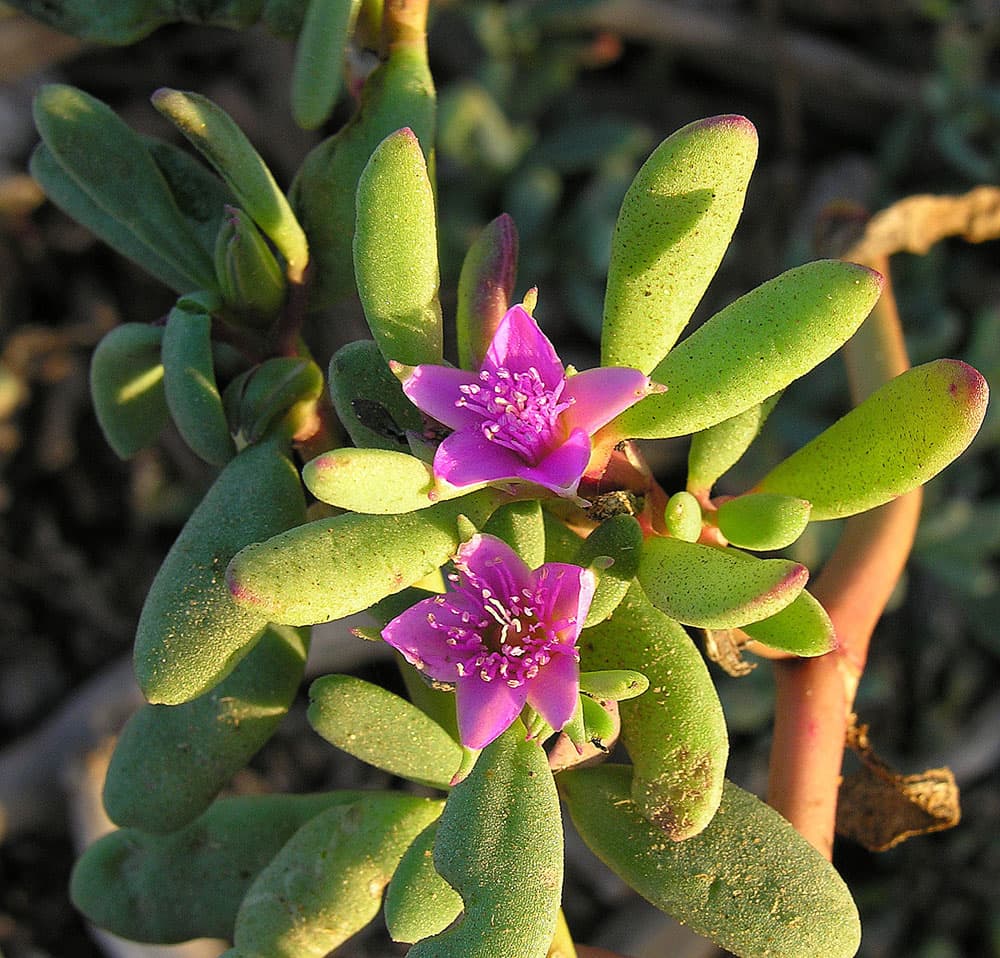
Сезувиум бородавчатый
Sesuvium verrucosum
also known as: Sesuvium erectum
2
Properties
- Foliage
- evergreen
- Climatic zone
- 8 (down to −7 °C)
- Life cycle
- perennial
- Plant type
- creeper
- Fruit type
- decorative
- Soil drainage
- strongly drained
- Height
- up to 0.5 m
- Width
- 1.5–2 m
- Flowering time
- June, July, August, September
- Fruiting time
- September
- Soil pH
- acidic, alkaline, neutral, slightly alkaline, weakly acidic
- Soil type
- sandy
- Sunlight
- partial shade, sun
- Properties
- Тропики и субтропики Северной и Южной Америки
About this plant
Updated: 4 months ago- Morphology
- Procumbent, perennial and often much-branched herb with a dense cover of bladder cells (except inner parts of flowers, lateral flaps, bracts); thick reddish taproot, often much longer than above ground parts of the plant; older plants lignify at the base; internodes (greyish-) green, up to 3 mm in diam. Leaves 5 – 30 mm long, oblong to oblanceolate, often with retuse apices, sometimes linear, petiolate (3 – 6 mm), slightly greyish-green (due to bladder cells), mostly flat but succulent.
- Growing conditions
- The species grows in saline areas (e. g. salt flats) and on sandy soil, often on gypsum or alkaline soil.
- Propagation
- In the greenhouse, fruit set by self-pollination and vegetative propagation via suckers were observed.
- Fruiting
- Fruit a beehive-shaped or ovoid capsule, usually many-seeded. Seeds around 1 mm long, rounded-reniform, black, lustrous, and slightly iridescent.
- Regional variations
- Local phenotypes differ more or less from one another in leaf shape and size but are nevertheless easily recognizable as S. oerrucosum.
Ask AI about «Сезувиум бородавчатый»
✅ Already grown by others
Set your city — we'll show what already grows for gardeners in your climate zone.
Set cityAdditional info
- Frost resistance
- до -5° C
- Reproduction by cuttings
- Yes
- Reproduction by seeds
- Yes
- Reproduction by bulbs
- No
- Medicinal properties
- Не обнаружены
- Edible
- No
- Toxic
- No
- Pests
- Среди вредителей, которые могут атаковать сезувиум, наиболее распространены тли, цикадки, трипсы и белокрылки. Для профилактики используйте настой табачной пыли, а при высокой численности вредителей применяйте специальные химические препараты, такие как “Биотлин” или “Цветолюкс БАУ”.
- Diseases
- Пятнистость листьев (чаще всего вызывается Bipolaris sesuvii) проявляется в виде округлых светлых пятен, заглубленных в ткань листа, или же коричневых пятен, в которых ткань высыхает, твердеет и покрывается коркой. В начальной стадии заболевания можно осторожно вырезать больные места острым ножом и посыпать порошком угля. Корневая гниль (возбудитель - Phymatatrichum omnivorum) может проявляться в виде размягчения корней, которые выглядят нормальными, но на разрезе имеют ржавую окраску. Внешние признаки включают внезапную остановку роста, блеклую окраску листьев и побегов, потерю тургора. Лечение включает обработку фунгицидами, таким как Скор, Раек.
- Watering
- Not required
