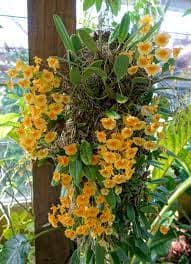
Дендробиум Линдли
Dendrobium lindleyi (Lindley's Dendrobium)
also known as: Lindley"s Dendrobium, Callista aggregata, Dendrobium aggregatum, Dendrobium alboviride var. majus, Dendrobium lindleyi var. majus, Epidendrum aggregatum, Dendrobium aggregatum Roxb., Callista aggregata (Roxb.) Kuntze
Genus:61f84d38a994cf1f88e16fcf0
Properties
- Foliage
- evergreen
- Climatic zone
- 9 (down to −1 °C)
- Life cycle
- perennial
- Plant type
- herbaceous
- Fruit type
- decorative
- Soil drainage
- strongly drained
- Height
- up to 0.5 m
- Width
- up to 0.5 m
- Flowering time
- February, March, April
- Fruiting time
- April, May, June
- Soil pH
- neutral
- Soil type
- loam
- Sunlight
- partial shade
- Properties
- Китай, Индия
About this plant
Updated: 4 months ago- Morphology
- Epiphytic herbs with a creeping rhizome, slender, 2 – 3 mm in diam, branched. Pseudobulbs suberect, ovoid, crowded, 4.0 – 8.0 × 1.0 – 2.0 cm, more or less octangular, and as many prominent subacute ridges, loosely covered with a grey, shining, wrinkled cuticle, and with 2 – 4 nodes, internodes 2.0 – 2.5 cm, the outer tapering. Leaf solitary, rarely two, oblong, 5.0 – 9.0 × 2.0 – 3.0 cm, base contracted, not sheathing, margin ± undulate, apex obtuse and emarginate, twice as long as the pseudobulbs.
- Growing conditions
- Epiphyte in seasonally dry forest, below 1000 m elevation.
- Fruiting
- Flowers orange-yellow, deepest towards the base of the lip; sepals ovate, united at their base where the two laterals form a mentum; petals ovate, broader and longer than the sepals, 20.0 × 12.0 mm, with a short claw; lip broader than long, 27.0 × 30.0 mm, entire, often emarginate; minutely pubescent in front, disk densely pubescent below middle, below middle contracted into a claw with the sides clasping column. Column streaked with red in front, with a truncate scale near base, slightly concave stigma, toothed at both sides of the anther, with a tooth-like filament. Anther bilocular, greenish; pollinia naked, terete, 4 in two pairs. (after Roxburgh 1832, Lindley 1835, Hooker 1839).
Ask AI about «Дендробиум Линдли»
✅ Already grown by others
Set your city — we'll show what already grows for gardeners in your climate zone.
Set cityAdditional info
- Frost resistance
- -1
- Reproduction by cuttings
- Yes
- Reproduction by seeds
- Yes
- Reproduction by bulbs
- No
- Medicinal properties
- Нет.
- Edible
- No
- Toxic
- No
- Pests
- Щитовки и пемфиги.
- Diseases
- При сырости возможно поражение грибками.
- Watering
- Every other day
